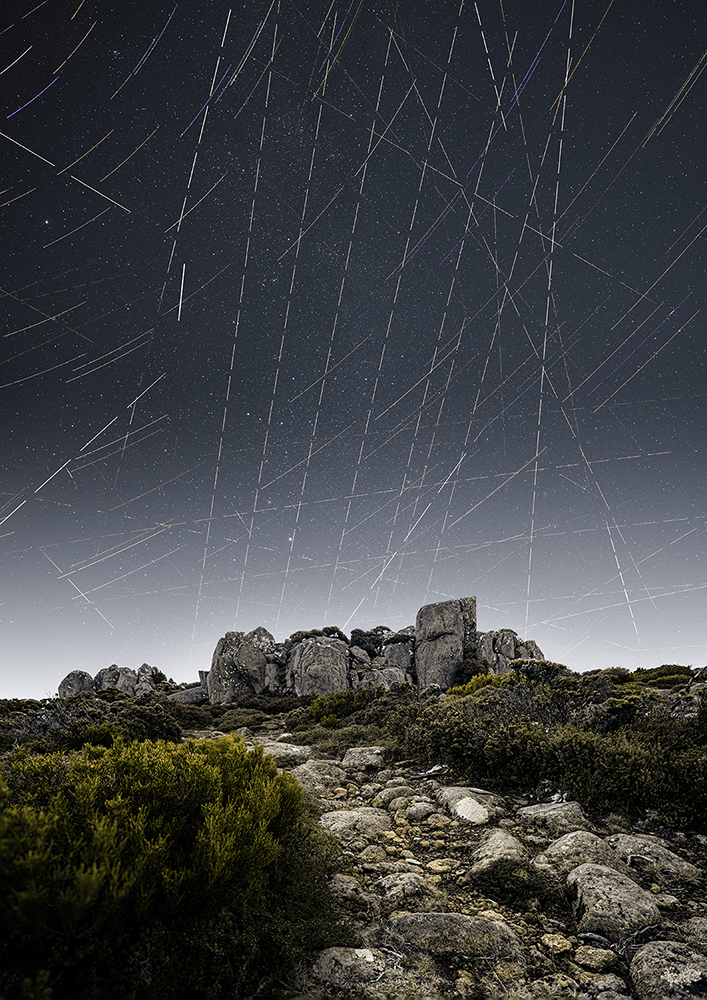
Satellite Trails Over Hobart Skies
David Nolan | @davidnolandesign
Satellite trails are an increasingly visible sign of human impact on the night sky. As large constellations of satellites expand, long streaks of reflected sunlight appear in astronomical images, interfering with observations and altering the natural darkness of space. This is closely tied to light pollution: while traditional light pollution comes from ground-based sources, satellites introduce a new, moving form of sky brightness. For astronomers and astrophotographers, these trails can obscure faint celestial objects and require complex processing to remove. More broadly, they represent a shift in how humanity occupies even the most remote environments, extending our technological footprint into orbit. Preserving dark skies now depends not only on reducing artificial lighting on Earth, but also on responsible satellite design, regulation, and deployment to minimise their visual and scientific impact.
BEAKER STREET SCIENCE PHOTOGRAPHY PRIZE
This photograph was a finalist in Beaker Street’s annual Science Photography Prize. This highly-respected prize invites amateur and professional photographers to showcase the wonders of our extraordinary part of the world — which is teeming with science and scientists. Finalist images are displayed at the Tasmanian Museum and Art Gallery during Beaker Street Festival each August, with great prizes on offer for Judges’ and People’s Choice winners.
The Beaker Street Science Photography Prize is sponsored by Pennicott Foundation — thank you crew! It would not be possible without the support of Full Gamut, Tasmania’s premier fine art printers, as well as the wonderful Tasmanian businesses who donate prizes.