
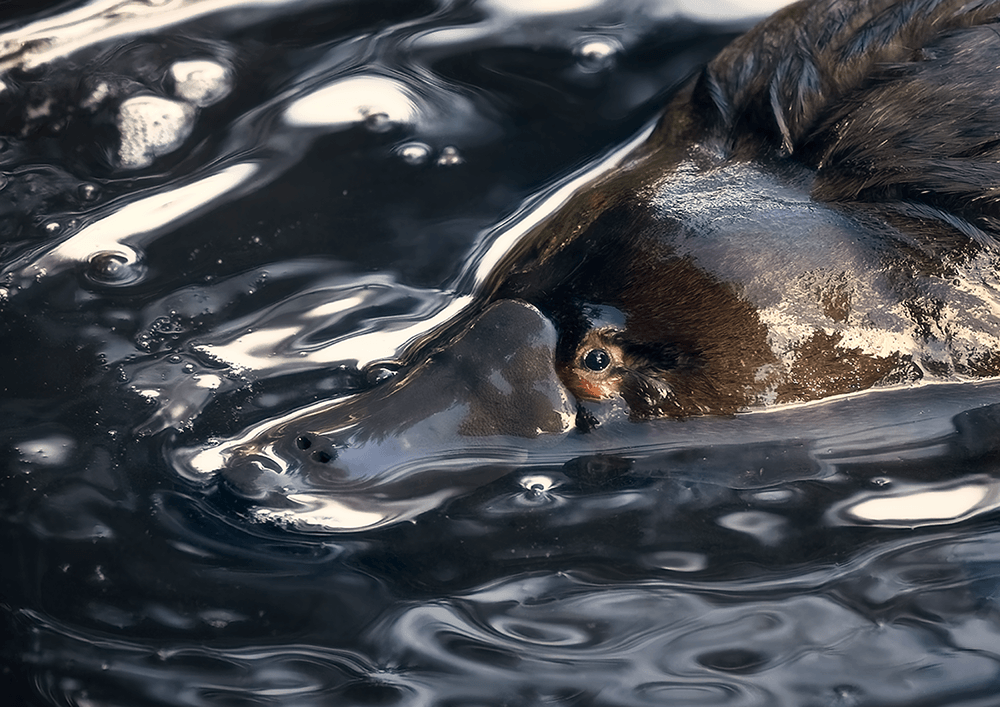
A Natural Wetsuit
Alex Wheeler | @alexdwheeler
The Platypus (Ornithorhynchus anatinus) has a two‑layered fur for maintaining thermal homeostasis in Tasmania’s cold, freshwater environments. Its outer coat consists of tightly packed guard hairs rich in natural oils that provide water resistance. Beneath this lies a layer of fine, wool‑like underfur that traps a stable layer of air against the skin. Together, these layers form a very effective thermal insulation. The air layer is retained during repeated diving, minimising convective heat loss when diving in rivers and alpine streams that can approach near‑freezing temperatures. The effectiveness of this insulation enables platypuses to sustain extended foraging, often for up to 12 hours per day without significant drops in core body temperature – essential for the species’ semi‑aquatic lifestyle and its distribution across Tasmania’s colder habitats.
BEAKER STREET SCIENCE PHOTOGRAPHY PRIZE
This photograph was a finalist in Beaker Street’s annual Science Photography Prize. This highly-respected prize invites amateur and professional photographers to showcase the wonders of our extraordinary part of the world — which is teeming with science and scientists. Finalist images are displayed at the Tasmanian Museum and Art Gallery during Beaker Street Festival each August, with great prizes on offer for Judges’ and People’s Choice winners.
The Beaker Street Science Photography Prize is sponsored by Pennicott Foundation — thank you crew! It would not be possible without the support of Full Gamut, Tasmania’s premier fine art printers, as well as the wonderful Tasmanian businesses who donate prizes.