
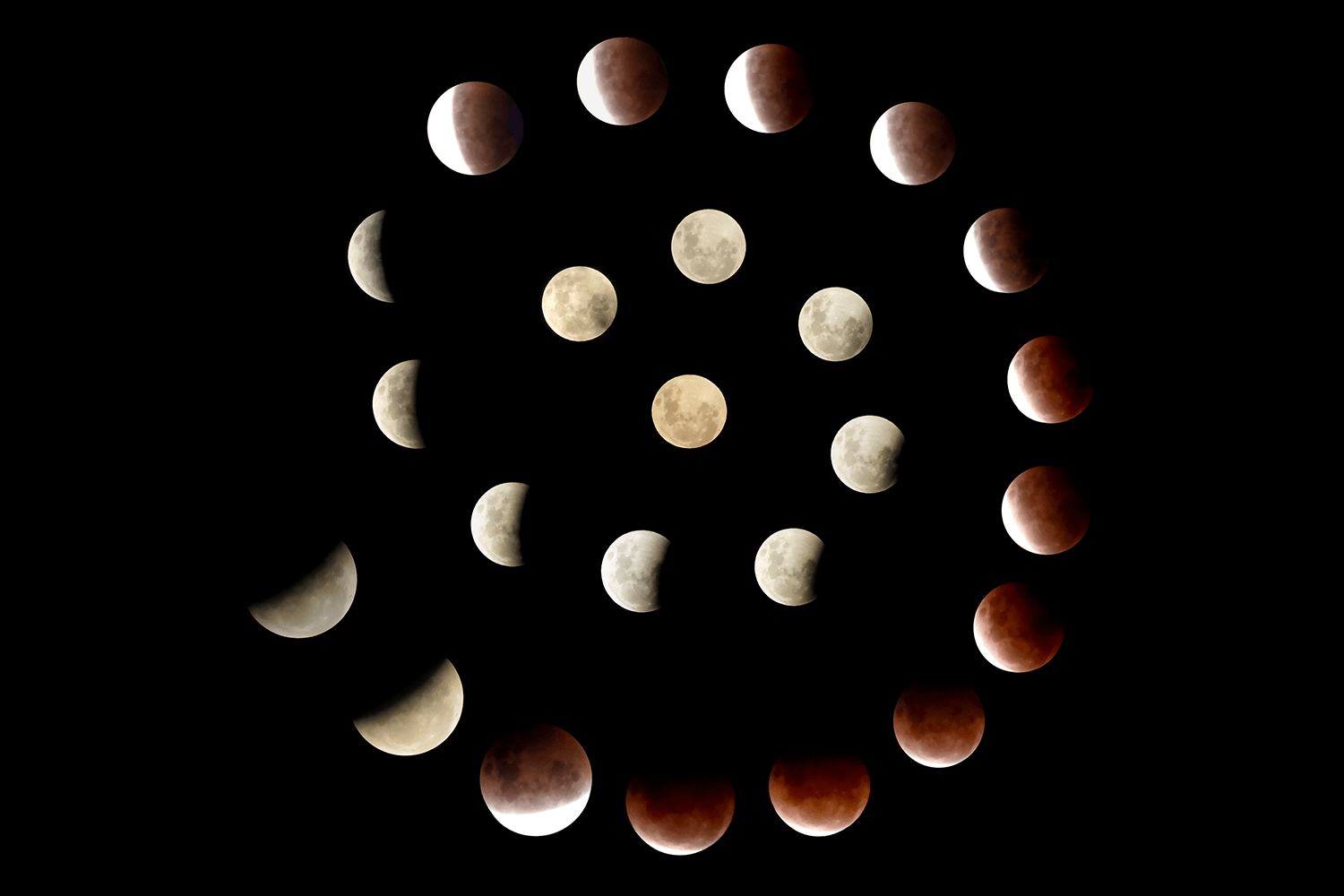
Lunar Spiral – Mt Pleasant Observatory – Tasmania
Bronwen Gunning
Humans have been observing and recording celestial events for thousands of years, with lunar eclipses holding a special fascination for us. This total eclipse was designated a ‘blood moon’ due to the reddish hue cast from Earth’s shadow and atmosphere. It was also a supermoon, so called because it appears larger than usual in our sky due to its close proximity to earth. This moment is called the perigree, at which point the moon is roughly 45,000 km closer to Earth than when it is at its farthest point in its elliptical orbit. It was a challenging event to observe and image with intermittent cloud cover throughout the night. My image depicts twenty-four separate photographs showing the progression of the eclipse through its many different phases. This image was produced specifically to demonstrate the timeline of the eclipse and is often used by me during public astronomy outreach sessions. Note that only basic photo editing software was used to scale and position the individual images. The spiral arrangement is purely for aesthetic and presentation purposes and doesn’t reflect the ‘movement’ of the moon in the night sky.
BEAKER STREET SCIENCE PHOTOGRAPHY PRIZE
This photograph was a finalist in Beaker Street’s annual Science Photography Prize. This highly-respected prize invites amateur and professional photographers to showcase the wonders of our extraordinary part of the world — which is teeming with science and scientists. Finalist images are displayed at the Tasmanian Museum and Art Gallery during Beaker Street Festival each August, with great prizes on offer for Judges’ and People’s Choice winners.
The Beaker Street Science Photography Prize is sponsored by Pennicott Foundation — thank you crew! It would not be possible without the support of Full Gamut, Tasmania’s premier fine art printers, as well as the wonderful Tasmanian businesses who donate prizes.