Reaching for a Monument of Tiny Danger
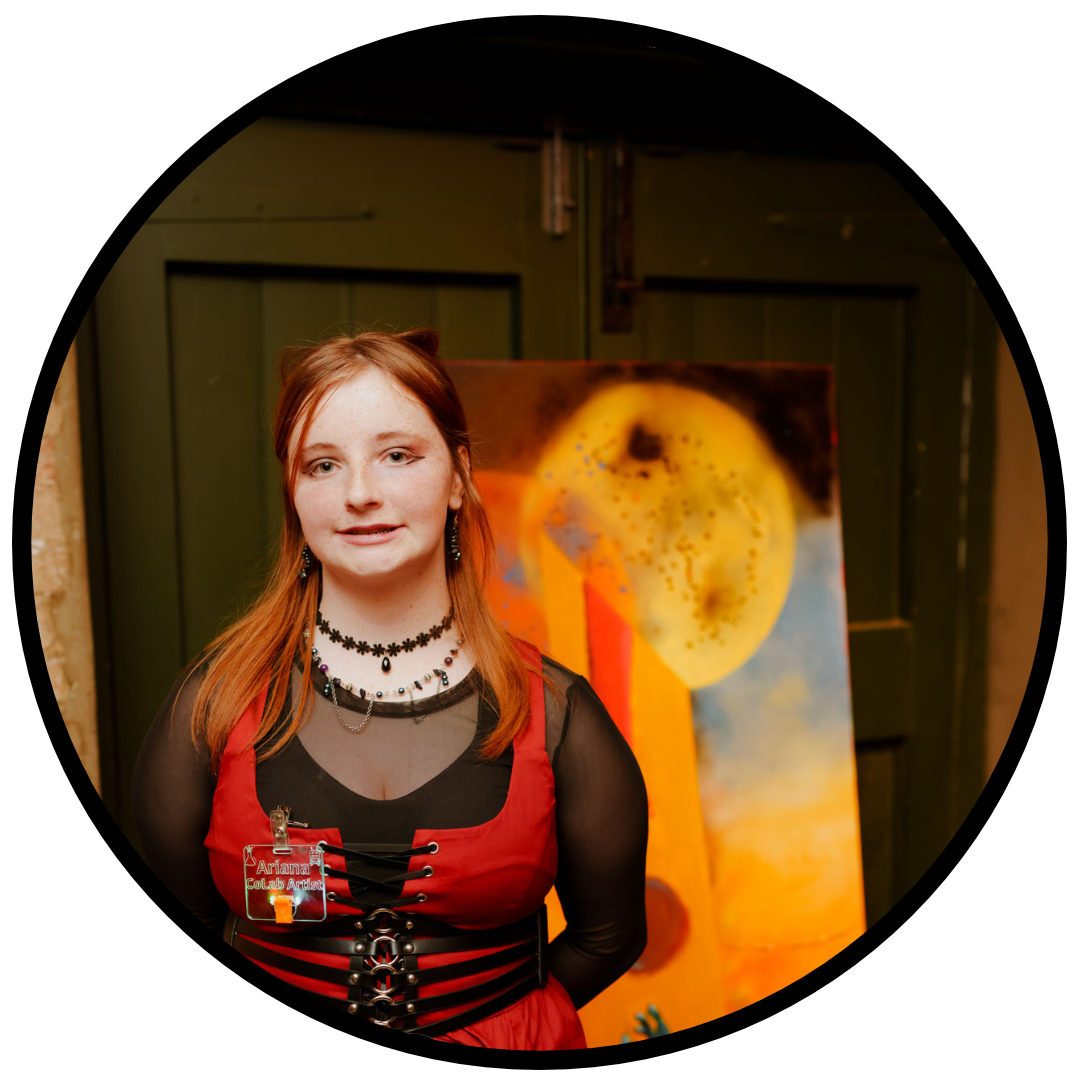
Ariarna Westbury, Hobart City High School
In collaboration with Dr Sophie Navickas
Menzies Institute for Medical Research, UTAS
Artist’s Statement
The idea for my artwork came from Sophie’s research on medulloblastoma, which is the most common malignant childhood brain cancer. Sophie is researching about whether brain cancer cells might respond to treatment with epigenetic inhibitors.
I enjoyed hearing about the cell lines and how old some of the cells were. We looked at a cell line that was derived from a 4-year-old child in the 80’s. It was interesting to look at images of the cell cycle and cell division. The cancer cells don’t stop dividing and multiplying which is why it is hard to get rid of the cancer as the cells are always making more.
After learning about medulloblastoma I was inspired to create a painting for my artwork. I wanted to go large to not only represent how big of a problem it is, but also to challenge myself. I wanted to incorporate elements from different parts of the lab visit in my design.
The colours for my painting represent the reds, oranges, yellows and blues that we saw in the cell imagery. The shapes of the central column are meant to resemble a scalpel, while the hands are smaller to show it’s most commonly a childhood disease. The strands of beads are to represent cell lines and the red hand’s fingers are in pieces to show that fine motor skills are affected by medulloblastoma as it sits on the brain stem. The circular elements are to represent cells, with the larger ones at the top representing mitosis. The central purple cell that the hands are reaching towards has been treated with an epigenetic inhibitor which is hopefully a solution for this terrible disease.
Project Gallery